
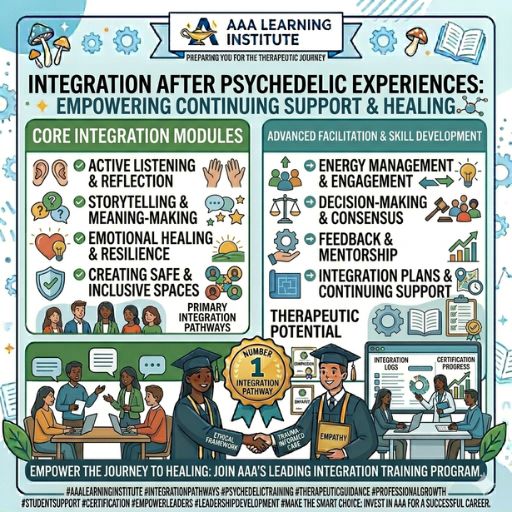
Understanding integration after psychedelic experiences is an important topic in psychological and educational discussions. Integration generally refers to the process of reflecting on insights, emotional responses, and behavioral patterns that may arise following altered states of consciousness. Many researchers and educators emphasize integration as a way to support meaning-making and personal learning.
Individuals exploring the neurological context of these experiences may also wish to review how psilocybin affects the brain or learn about neuroplasticity and psychedelics.
Why Integration Is Often Discussed
Integration after psychedelic experiences is frequently mentioned in educational materials because individuals may report changes in perspective, emotional awareness, or motivation. Reflective practices such as journaling, dialogue, and mindfulness are sometimes explored as ways to process experiences.
Readers interested in psychological context may also wish to explore psychedelics and emotional processing.
Influence of Context and Preparation
Preparation and environmental factors may influence how individuals interpret experiences afterward. Understanding set and setting can help clarify how mindset and surroundings may contribute to both the experience itself and subsequent integration.
Additional preparation considerations are discussed in psychedelic preparation practices.
Integration and Mental Health Research
Scientific discussions about integration after psychedelic experiences often explore potential psychological outcomes in structured research settings. Academic studies and nonprofit research organizations continue to investigate these topics in relation to well-being and behavioral change.
Readers interested in broader scientific context may find it helpful to review psychedelic research in mental health.
Safety and Risk Awareness
While many educational discussions focus on learning and reflection, safety considerations are also important. Understanding risks of psychedelic experiences and awareness of contraindications for psilocybin can support more informed conversations about preparation and integration.
Connections to Professional Education
Topics related to integration after psychedelic experiences may be included in structured training programs for individuals preparing for professional roles. Those interested in educational pathways can review psilocybin facilitator training to understand how psychological support concepts may be addressed.
Prospective students may also explore the training structure and curriculum, the program overview, or begin the enrollment process through the application page.
Ongoing Scientific Perspectives
Organizations such as MAPS and university psychology programs continue to study how integration processes relate to learning, behavior, and emotional adaptation following altered states.
Final Consideration
Integration after psychedelic experiences is a developing area of psychological and educational interest. As research evolves, reflective practices, contextual awareness, and structured learning discussions are likely to remain central to conversations about personal insight and long-term behavioral change.