
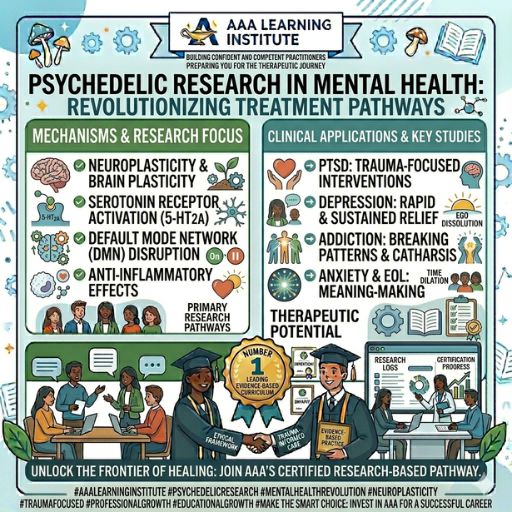
Interest in psychedelic research in mental health has grown as scientists explore how altered states of consciousness may relate to emotional awareness, cognitive flexibility, and behavioral change. Researchers continue to investigate psychological and neurological processes in structured clinical and academic settings.
Individuals seeking foundational neuroscience context may also wish to review how psilocybin affects the brain. Additionally, understanding neuroplasticity and psychedelics can help explain how learning and adaptation may occur at the neural level.
Historical and Contemporary Research Perspectives
Scientific interest in psychedelic research in mental health has evolved over several decades. Early exploratory studies focused on perception and cognition, whereas modern research often examines psychological well-being, emotional processing, and structured therapeutic environments. Consequently, academic institutions now conduct carefully designed investigations into these topics.
Readers who want to explore psychological context further may find it helpful to review psychedelics and emotional processing.
Clinical Research and Structured Settings
Researchers typically conduct studies in controlled environments that emphasize preparation, observation, and follow-up reflection. Therefore, educational discussions often highlight the importance of set and setting when interpreting experiential outcomes.
Similarly, preparation strategies appear in psychedelic preparation practices, which examines how individuals may prepare psychologically before participating in structured research contexts.
Integration and Psychological Adaptation
Many research discussions also consider how participants process experiences afterward. As a result, integration practices such as reflection and dialogue frequently appear in academic literature. Readers may wish to explore integration after psychedelic experiences to understand how insight and behavioral awareness may develop over time.
Safety Awareness in Research Contexts
Although researchers study potential psychological outcomes, safety considerations remain central. For example, individuals may review risks of psychedelic experiences and explore contraindications for psilocybin to better understand factors that influence research participation criteria.
Academic Organizations and Ongoing Studies
Organizations such as MAPS and university neuroscience programs continue to contribute to psychedelic research in mental health. In addition, peer-reviewed journals and clinical research initiatives provide evolving insights into psychological and neurological outcomes.
Relevance for Professional Education
Scientific discussions often influence educational frameworks for individuals preparing for professional roles. Therefore, prospective learners may review psilocybin facilitator training to understand how research awareness can support responsible practice.
Further program information appears on the training structure and curriculum, the program overview, and the application page.
Final Consideration
Psychedelic research in mental health continues to develop as scientists explore psychological, neurological, and behavioral dimensions of altered states. As academic understanding expands, educational programs and public discussions increasingly emphasize preparation, safety awareness, and reflective learning.