
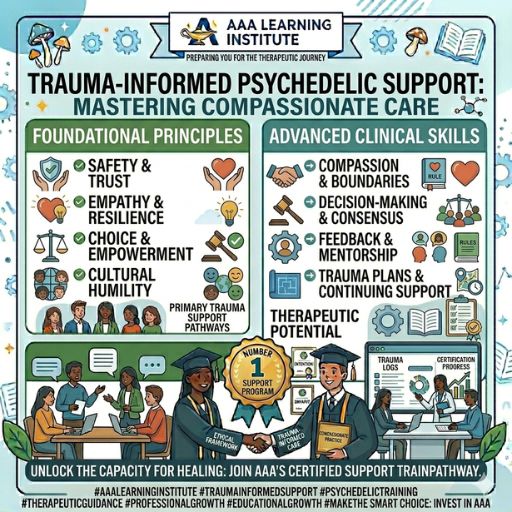
Understanding trauma informed psychedelic support helps individuals explore psychological safety and responsible preparation. In many educational discussions, trauma-informed approaches emphasize emotional awareness, supportive communication, and intentional environmental design. As a result, these approaches aim to reduce distress during intense experiences.
For example, individuals who want to understand neurological influences may also explore how psilocybin affects the brain. Additionally, reviewing neuroplasticity and psychedelics can help readers connect psychological experience with biological processes.
Understanding Trauma-Informed Perspectives
Trauma-informed frameworks recognize that past experiences can shape current perception and emotional response. Therefore, educational programs often encourage facilitators and students to develop sensitivity to pacing, language, and interpersonal boundaries. In contrast to purely academic learning, this approach focuses on practical awareness and real-world interaction.
Moreover, readers who want deeper insight into emotional dynamics may also review psychedelics and emotional processing.
Importance of Environment and Preparation
Environment plays a significant role in trauma informed psychedelic support. For instance, comfortable surroundings, predictable structure, and intentional preparation can influence how individuals interpret experiences. Consequently, many educational discussions highlight set and setting as a foundational concept.
Similarly, additional guidance appears in psychedelic preparation practices, which explores how preparation may support psychological readiness.
Safety Awareness and Risk Considerations
Trauma-informed perspectives also encourage proactive safety awareness. For example, individuals often review risks of psychedelic experiences to understand potential challenges. Furthermore, awareness of contraindications for psilocybin can help people evaluate personal readiness more thoughtfully.
Integration and Continued Support
After intense experiences, reflection frequently continues. Therefore, trauma informed psychedelic support discussions often include integration practices such as journaling, dialogue, or mindfulness exercises. Readers may wish to explore integration after psychedelic experiences to better understand how insight and emotional processing can develop over time.
Research and Educational Context
Researchers continue to study trauma-informed approaches in psychological and wellness settings. For instance, organizations such as MAPS contribute to ongoing research and public education. In addition, broader scientific perspectives appear in psychedelic research in mental health.
Connections to Professional Training
Structured training programs often include discussions about trauma informed psychedelic support. Therefore, individuals considering educational pathways may review psilocybin facilitator training to understand how emotional safety concepts appear in coursework.
Likewise, prospective students can explore the training structure and curriculum, read the program overview, or proceed to the application page when ready.
Final Consideration
Overall, trauma informed psychedelic support represents an evolving area of discussion in psychology and education. As research continues, professionals and learners increasingly emphasize emotional awareness, environmental sensitivity, and integration practices. Consequently, these concepts remain central to conversations about responsible preparation and psychological well-being.