
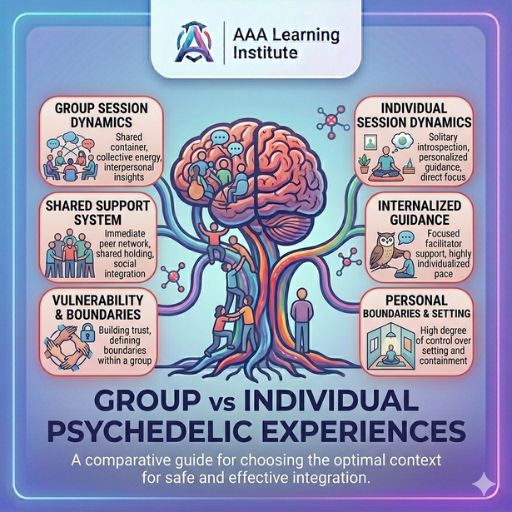
Understanding group vs individual psychedelic experiences can help individuals explore how social context, environmental structure, and psychological readiness may influence altered state perception. Educational discussions often compare these formats to highlight differences in emotional processing, preparation approaches, and integration considerations.
Readers who want neurological context may also explore how psilocybin affects the brain. In addition, reviewing neuroplasticity and psychedelics can help explain how experiential interpretation may relate to shifts in brain connectivity.
Social Context and Shared Environment
Group psychedelic experiences typically involve shared space and collective structure. For example, individuals may feel influenced by the presence of others, group expectations, or communal atmosphere. Consequently, educational materials often discuss set and setting when comparing group and individual formats.
Preparation considerations also appear in psychedelic preparation practices, which explore mindset awareness and environmental planning.
Personal Focus and Internal Reflection
Individual psychedelic experiences may provide greater opportunity for inward attention and self-directed reflection. Therefore, discussions of psychedelics and emotional processing often reference how psychological insight may unfold differently depending on social context.
Post-experience reflection is frequently explored in integration after psychedelic experiences.
Safety Awareness in Different Formats
Educational discussions of group vs individual psychedelic experiences also consider safety planning. For instance, individuals may review risks of psychedelic experiences and explore contraindications for psilocybin to better understand readiness factors.
Additional preparation awareness appears in safety screening before psychedelic sessions.
Supportive Presence and Emotional Sensitivity
Some educational frameworks emphasize the importance of emotional support regardless of format. Awareness of trauma informed psychedelic support may help individuals understand how psychological safety considerations apply in both group and individual settings.
Research and Educational Perspectives
Academic institutions continue to study group vs individual psychedelic experiences within structured environments. Organizations such as MAPS and university research programs contribute to evolving understanding of contextual influences on experiential interpretation.
Readers seeking broader scientific context may also explore psychedelic research in mental health.
Connections to Professional Training
Comparative discussions about group vs individual psychedelic experiences may appear in structured education programs for individuals preparing for facilitation roles. Prospective learners may review psilocybin facilitator training to understand how contextual awareness topics are addressed in coursework.
Additional information can be found on the training structure and curriculum, the program overview, or by visiting the application page.
Final Consideration
Exploring group vs individual psychedelic experiences can help individuals better understand how social environment, preparation practices, and emotional readiness may influence altered state perception. As research continues to evolve, educational discussions increasingly emphasize contextual awareness, safety planning, and reflective integration.