
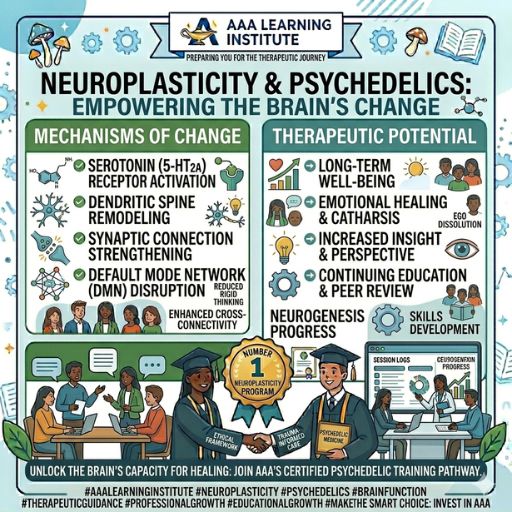
Interest in neuroplasticity and psychedelics has increased as researchers explore how psychedelic compounds may influence brain adaptation and learning processes. Neuroplasticity refers to the brain’s ability to reorganize connections and develop new patterns of activity in response to experience. Understanding this concept can help explain why psychedelic experiences are often described as psychologically significant.
Individuals new to this topic may also wish to review how psilocybin affects the brain to gain additional context on neurological mechanisms associated with psychedelic compounds.
What Neuroplasticity Means
Neuroplasticity is a natural process through which the brain changes and adapts across the lifespan. Learning new skills, forming memories, and responding to emotional experiences all involve shifts in neural connectivity. Some scientific discussions explore how altered states of consciousness may temporarily increase flexibility in these neural networks.
Readers interested in psychological preparation factors may also find it helpful to explore set and setting explained, which examines how mindset and environment can influence experiential outcomes.
Psychedelics and Brain Network Flexibility
Research on neuroplasticity and psychedelics often focuses on changes in communication between brain regions. Neuroimaging studies suggest that psychedelic compounds may reduce rigid patterns of neural activity, allowing new connections to form temporarily. These shifts are sometimes associated with changes in perception and cognitive processing.
Additional discussion of emotional experience can be found in psychedelics and emotional processing, which explores how psychological awareness may be influenced during altered states.
Learning, Behavior, and Psychological Integration
Some researchers explore whether neuroplasticity and psychedelics may relate to learning and behavioral adaptation following significant experiences. Because integration practices are often emphasized in education and wellness discussions, readers may also wish to review integration after psychedelic experiences.
Scientific Research and Ongoing Questions
The relationship between neuroplasticity and psychedelics continues to be studied in academic and clinical settings. Research organizations such as MAPS and university neuroscience departments contribute to evolving scientific understanding in this area.
Readers interested in broader scientific context may also explore psychedelic research in mental health.
Implications for Professional Education
Understanding neuroscience concepts can be valuable for individuals preparing for professional training pathways. Reviewing psilocybin facilitator training can provide insight into how brain science knowledge may support responsible facilitation practices.
Prospective students may also review the training structure and curriculum, the program overview, or begin exploring enrollment through the application page.
Final Consideration
Research into neuroplasticity and psychedelics continues to evolve as scientists explore how altered states of consciousness may influence brain function and learning processes. As understanding grows, educational programs, clinical studies, and public interest in neuroscience perspectives on psychedelic experiences are likely to expand.