
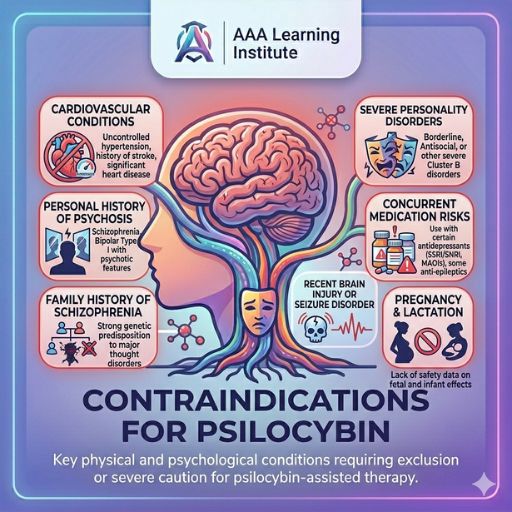
Understanding contraindications for psilocybin is an important part of responsible education and safety awareness. Contraindications generally refer to health or psychological factors that may increase risk or require additional evaluation before participating in altered-state experiences. Therefore, many research programs and educational discussions emphasize screening and preparation as key components of safety.
Readers who want to explore neurological context may also review how psilocybin affects the brain. In addition, understanding neuroplasticity and psychedelics can provide insight into how perception and cognition may change during psychedelic states.
Why Contraindications Are Discussed
Contraindications for psilocybin are commonly addressed in educational materials because individuals may respond differently to altered states. For example, psychological history, current stress levels, or certain medical conditions may influence safety considerations. As a result, many discussions include the importance of safety screening before psychedelic sessions.
Mental Health and Psychological Readiness
Some educational discussions of contraindications for psilocybin focus on emotional readiness and personal history. Individuals may review trauma informed psychedelic support to understand how past experiences can shape perception and response.
Similarly, awareness of emotional intensity appears in risks of psychedelic experiences and psychedelics and emotional processing.
Physical Health Considerations
In some cases, contraindications for psilocybin may include physical health factors or medication interactions. Educational resources often encourage individuals to review preparation practices and seek appropriate guidance. Readers may wish to explore psychedelic preparation practices for broader context on readiness planning.
Influence of Environment and Preparation
Environmental conditions can also influence experiential outcomes. Therefore, many educational discussions highlight set and setting as an important concept related to safety awareness and psychological interpretation.
Integration and Follow-Up Reflection
After intense experiences, reflective practices are often recommended in educational contexts. Readers may benefit from reviewing integration after psychedelic experiences to understand how insight and emotional processing may continue over time.
Research Perspectives and Ongoing Study
Academic institutions continue to examine contraindications for psilocybin within structured research environments. Organizations such as MAPS and university research programs contribute to evolving safety discussions and clinical awareness.
Broader scientific context can be found in psychedelic research in mental health.
Connections to Professional Education
Topics related to contraindications for psilocybin are often included in structured training programs for individuals preparing for facilitation roles. Prospective learners may review psilocybin facilitator training to understand how screening and safety awareness are introduced in coursework.
Further information appears on the training structure and curriculum, the program overview, or by visiting the application page.
Final Consideration
Awareness of contraindications for psilocybin supports informed decision-making and responsible preparation. As research continues to develop, educational discussions increasingly emphasize individualized readiness, environmental awareness, and integration planning as part of balanced safety-focused learning.